

Market Volatility: Trades Doubled as VIX Hit 40 | ELITE Tape
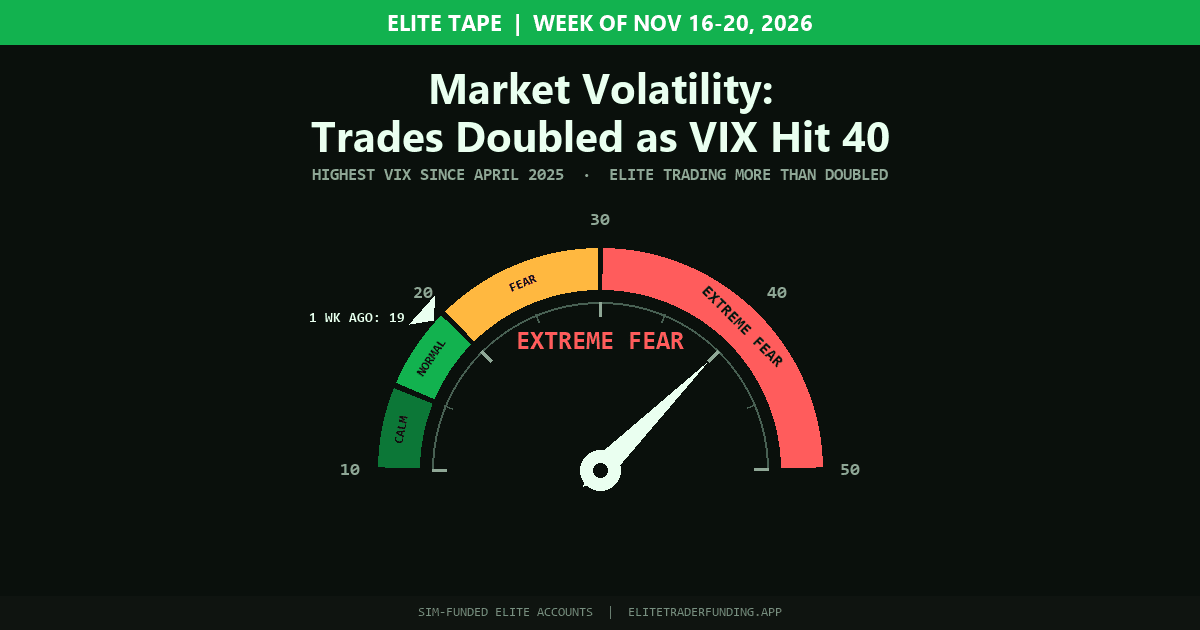
Market volatility spiked as the VIX hit 40 and stocks fell into a correction. ELITE trading more than doubled from Monday, and the busiest days lost most.
Market Volatility: The VIX Hit 40 and ELITE Trading Doubled

Market volatility took over the week of November 16: the VIX, Wall Street's fear gauge, climbed from about 19 to close near 36 and briefly touched 40 on Friday. ELITE trading followed it up. Thursday and Friday each ran at more than twice Monday's activity, and those two days carried close to six of every ten dollars of the week's net loss.
Elite Trader Funding is a futures prop firm for traders who want uncapped LIVE ELITE withdrawals, and this recap sets ELITE accounts' position P/L next to one of the most volatile weeks of the year. The S&P 500 and the Dow closed Friday in a correction, the Nasdaq had its worst week since March 2020, and every ELITE weekday finished red. First comes the day-by-day story with the VIX beside it, then where the trading went, what made money and what cost the most.
Key Takeaways
- The VIX rose about 86% over the week and closed above 30 for the first time since March. The S&P 500 and Dow closed Friday in a correction, and the Nasdaq fell about 10%.
- ELITE trading on Thursday and Friday each ran at more than twice Monday's level, and the two busiest days were also the two days with the highest VIX closes.
- Thursday and Friday carried close to six of every ten dollars of the week's net loss. All five weekdays finished red, and the week's net loss was about double the week before.
- NASDAQ futures, Micro E-mini NASDAQ-100 (MNQ) and E-Mini NASDAQ-100 (NQ), made up about three quarters of the net loss.
- Crude Oil (CL), Ultra US Treasury Bond (UB) and E-Micro British Pound (M6B) led a short profit list: seven of the 29 instruments ELITE accounts traded finished positive.
Here is how the week unfolded, one session at a time.
Each Day as Market Volatility Built
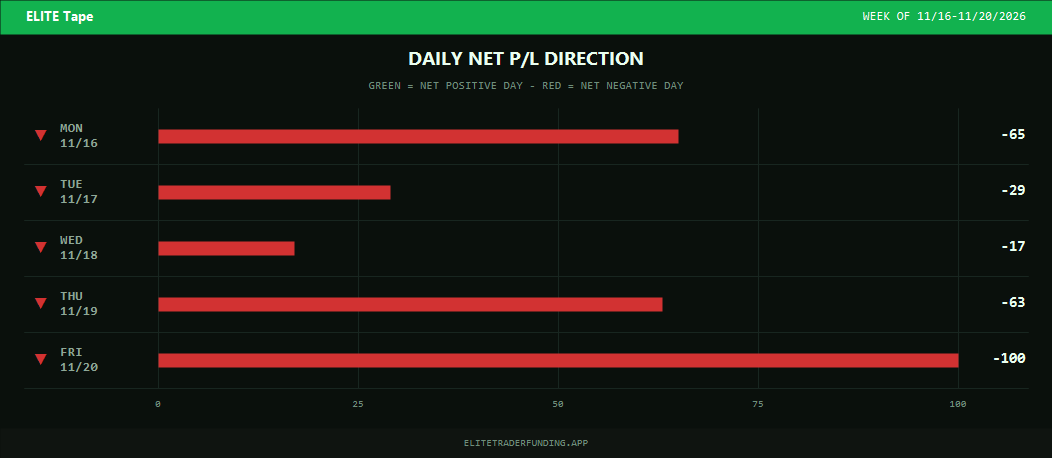
Not one weekday finished green for ELITE accounts. Friday cost the most, Monday came second, then Thursday and Tuesday, and Wednesday was the lightest.
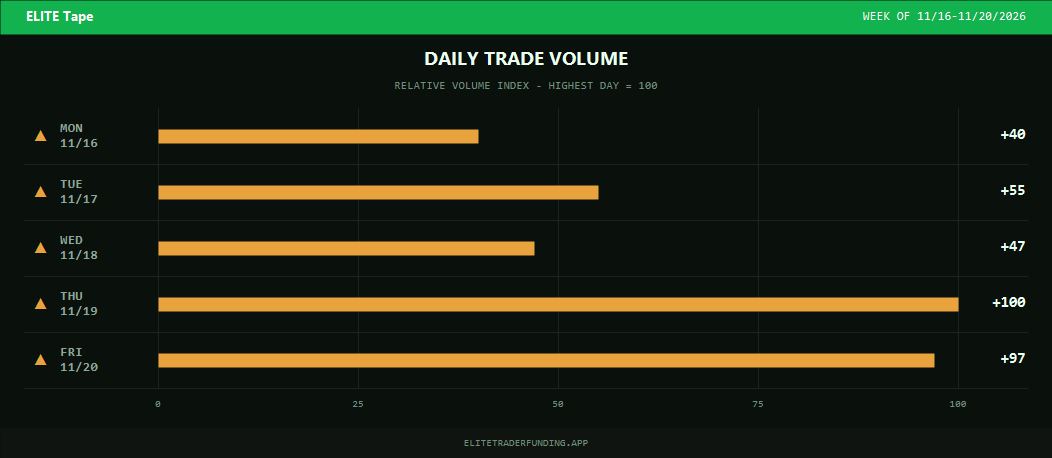
- Mon 11/16: Relative volume lowest of the week; Net Loss (2nd Heaviest). VIX closed near 23.
- Tue 11/17: Relative volume 3rd highest of the week; Net Loss (4th Heaviest). VIX closed near 25.
- Wed 11/18: Relative volume 4th highest of the week; Net Loss (Lightest). The VIX's only down day of the week.
- Thu 11/19: Relative volume highest of the week; Net Loss (3rd Heaviest). VIX closed near 28.
- Fri 11/20: Relative volume 2nd highest of the week; Net Loss (Heaviest). VIX touched 40 and closed near 36.
In the news, the week got worse as it went. Monday, a broad tech selloff sent the Nasdaq down 2.5% and Nvidia down 4%. Tuesday, the Dow fell about 850 points and the S&P 500 and Nasdaq posted their first four-day losing streak since September. Wednesday, Nvidia's early gain after earnings reversed, Fed minutes pointed to more rate hikes, and the Nasdaq still eked out a small gain. Thursday, the Anthropic IPO began trading and the Dow fell more than 1,100 points after the Nasdaq opened up as much as 2%. Friday, Nvidia fell 14% on a report of an SEC accounting probe, the S&P 500 dropped 3.7% into a correction and the Nasdaq fell 5.3%, and the VIX spiked to 40, its highest since April 2025.
Line those days up with the ELITE numbers and a pattern shows. The two days with the highest VIX closes, Thursday and Friday, were ELITE accounts' two busiest days, and Wednesday, the one day the VIX fell, was the lightest loss. Monday was the exception: the quietest day of ELITE trading still finished as the second heaviest loss. We show the market and the VIX here for timing only; they are not offered as the reason ELITE accounts finished where they did.
Trading More Than Doubled on the Two Biggest Days
Monday, the start of the selloff, was the lightest ELITE session of the week. By Thursday and Friday, activity had more than doubled from Monday's level, and those two days together made up close to six of every ten ELITE trades for the week.
Thursday was the swing day: the Nasdaq-100 traded more than 2% above Wednesday's close at its high and finished about 2.2% lower. Friday was one way, a slide that started early and closed near the low. The busiest ELITE stretch of the week landed on those two sessions, and so did most of the week's loss.
NASDAQ Futures Took Most of the Activity
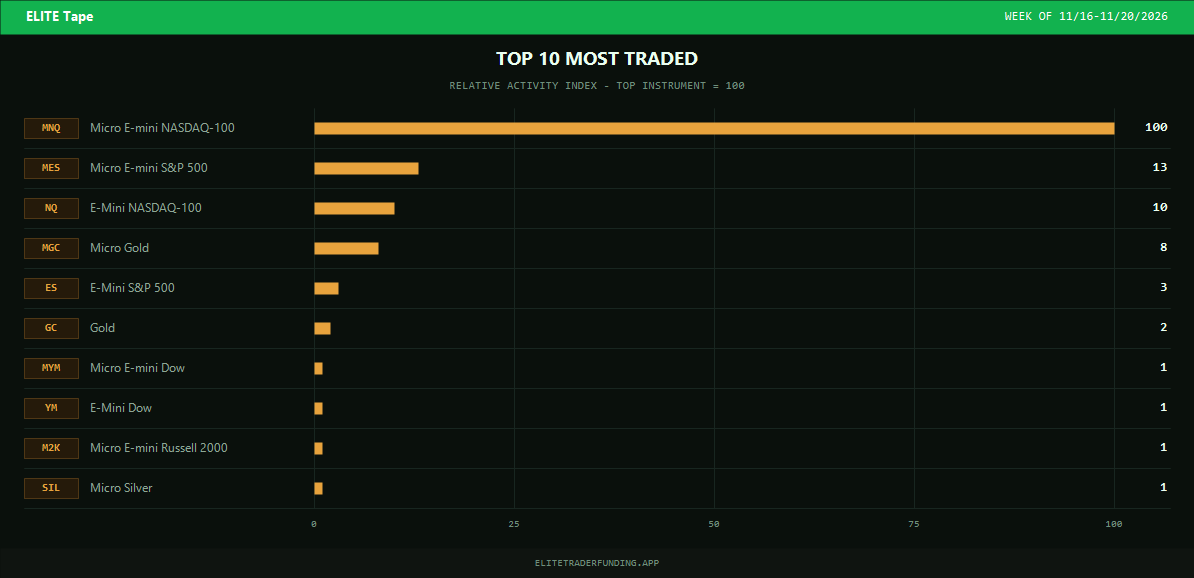
Micro E-mini NASDAQ-100 (MNQ) led ELITE trading volume, about seven of every ten ELITE trades on its own. Micro E-mini S&P 500 (MES) was second, followed by E-Mini NASDAQ-100 (NQ), Micro Gold (MGC), E-Mini S&P 500 (ES), and Gold (GC). Micro E-mini Dow (MYM), E-Mini Dow (YM), Micro E-mini Russell 2000 (M2K), and Micro Silver (SIL) completed the top 10.
In the Nasdaq's worst week since March 2020, ELITE activity leaned even harder into NASDAQ futures than usual, so the week's result mostly reflects how ELITE accounts traded that one index through the selloff.
Crude Oil and Treasurys Led a Short Profit List
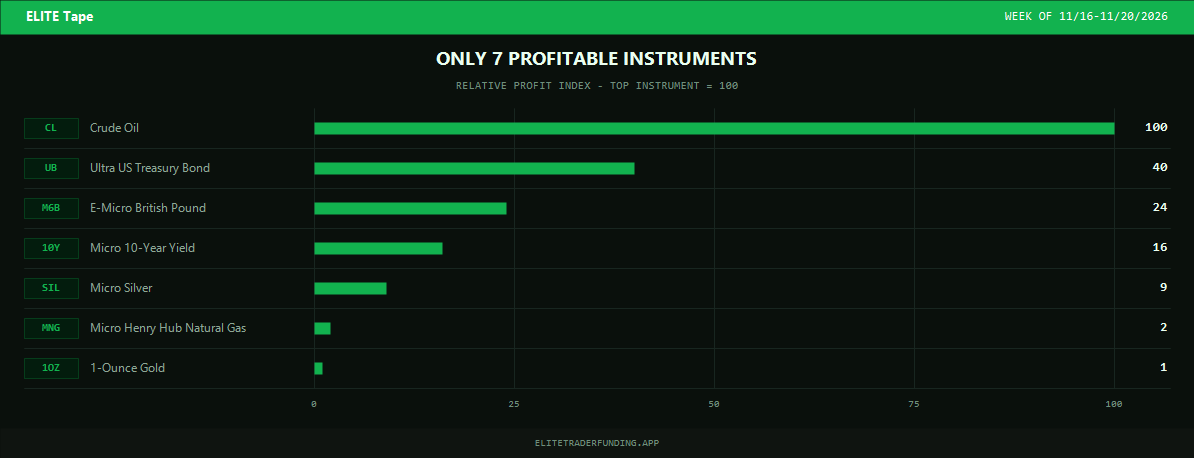
Crude Oil (CL) topped the profit list, followed by Ultra US Treasury Bond (UB), E-Micro British Pound (M6B), Micro 10-Year Yield (10Y), Micro Silver (SIL), Micro Henry Hub Natural Gas (MNG), and 1-Ounce Gold (1OZ). Only seven of the 29 instruments ELITE accounts traded finished positive, so the list stops at seven this week.
The crude oil gain came from short trades in a week when oil fell for a third straight week. The Treasury bond gain came from long trades as the 10-year Treasury yield fell every day of the week, and the pound gain came from short trades while the pound slipped about 1% against the dollar.
NASDAQ Futures Carried About Three Quarters of the Loss
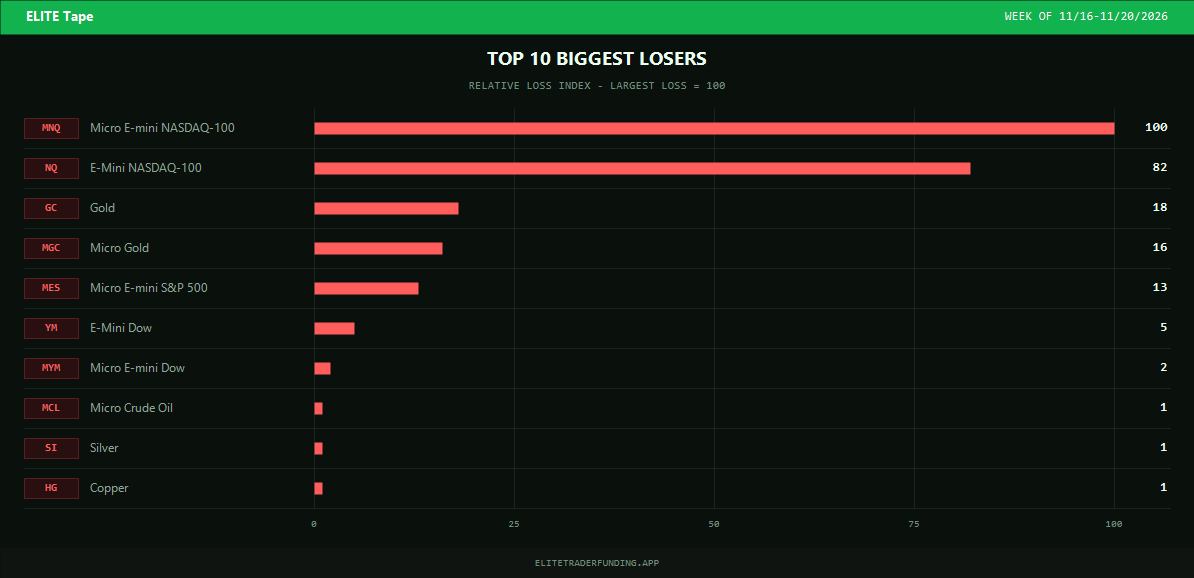
Micro E-mini NASDAQ-100 (MNQ) led the loss column, with E-Mini NASDAQ-100 (NQ) second, and the pair made up about three quarters of the week's net loss. Gold (GC) was third, then Micro Gold (MGC), Micro E-mini S&P 500 (MES), E-Mini Dow (YM), Micro E-mini Dow (MYM), Micro Crude Oil (MCL), Silver (SI), and Copper (HG).
Gold was the other steady loss. Gold (GC) and Micro Gold (MGC) together finished red on all five weekdays, mostly from long trades, as gold had its worst week since March and spot gold fell to its lowest level since September 2025.
Planning for the next volatile week? Browse available evaluations and choose the account size and drawdown style that fit how you trade.
Pattern Section
Streaks and frequency data we're watching:
- NQ (E-Mini NASDAQ-100): back in the loss column, where it has been throughout our tracking. MNQ (Micro E-mini NASDAQ-100) is a top-10 loss instrument for a 17th straight week.
- GC (Gold): a top-10 loss instrument for a 4th straight week; Gold and Micro Gold together finished red on every weekday for a second week running.
- MYM (Micro E-mini Dow) and MCL (Micro Crude Oil): each a top-10 loss instrument for a 3rd straight week.
- UB (Ultra US Treasury Bond) and M6B (E-Micro British Pound): on the profit list for the first time in at least six weeks.
- MES (Micro E-mini S&P 500): from last week's top profit instrument to a top-10 loss instrument.
Ready to Trade the Next Spike in Market Volatility?
Market volatility like this week's can make trading feel urgent, and ELITE accounts traded most on the days the VIX ran highest. Think about your own trading in a week like this one: whether your busiest days were planned or pulled in by the moves, and whether your size changed when the swings got bigger. Before the next spike, the ATD Calculator shows which of your trading days would count as Active Trade Days toward a reward, so a burst of extra trading has a clear purpose. If you want a fixed drawdown floor that doesn't trail, look at the Static evaluation (see how the Static plan works and how rewards work). Want more than one account size or plan? Add several to the cart and check out once. Next week is a holiday-shortened one for US markets, which makes it a good moment to review before the next swing comes.
About ELITE Accounts at Elite Trader Funding
ELITE accounts are sim-funded. The figures in these recaps are position P/L from those accounts, not LIVE ELITE results. Traders reach an Elite Sim-Funded account either by passing an evaluation or by purchasing a Direct to Funded (DTF) account, which skips the evaluation step, and those who do well may progress to LIVE ELITE, Elite Trader Funding's real-capital program, where withdrawals are uncapped above your onboarding balance.
Related Articles
- Market Rally: ELITE Accounts Still Finished Red (last week, a smaller loss in a rising market)
- Whipsaw Trading: Both Sides Got Caught (an earlier week of sharp swings)
- CPI Trading: Hot CPI Day Cost the Most (when one volatile day decided the week)
- Overtrading? October's Busiest Week Lost Least (the October recap, on activity and results)
Elite Trader Funding offers evaluation paths for every stage on the way to uncapped LIVE ELITE withdrawals, for traders who want to test themselves through the next round of market volatility. Evaluations are available for every account size. Real trader results, community feedback, and program details are available through Elite Trader Funding's testimonials, Elite Points program, affiliate program, and trading competitions.
Accuracy note: Figures in this recap are aggregated position P/L across ELITE accounts for November 16 to November 20, 2026, shown as relative indexes, shares and directions, and include a small number of weekend bitcoin futures trades closed on November 15 and 21. They are not any individual trader's results. ELITE accounts on Tradovate are covered; a small number of ELITE accounts on other platforms are not included.
Risk Disclosure: ELITE accounts operate in a simulated trading environment. Futures trading involves substantial risk of loss, and past performance of simulated accounts is not indicative of future results.
Pricing and Product Disclaimer: Pricing, promotions, and product details referenced in this article reflect information available at the time of publication and may have changed. Visit the evaluations page for current pricing.