

ELITE Tape | MNQ Futures Prop Firm: The Rebound Day Hurt the Most
See why MNQ futures prop firm traders watched ELITE accounts post their worst session of the week on the same day Nasdaq staged its sharpest rally.
MNQ Futures Prop Firm: The Rebound Day Hurt the Most

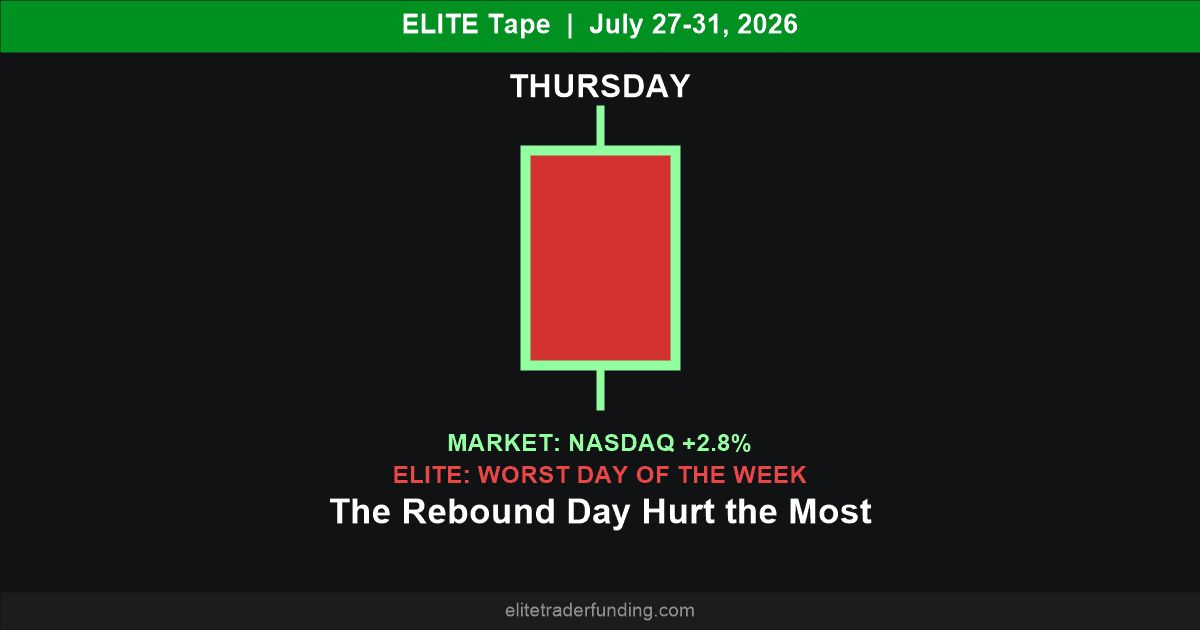
Traders researching an MNQ futures prop firm found a notable pattern in ELITE accounts data this week: Micro E-mini NASDAQ-100 (MNQ) held its usual spot as the single most-traded instrument, while the week's single worst trading session actually landed on the day the broader market rallied hardest, not the day it sold off.
ETF is a futures prop firm for traders who want uncapped Live Elite rewards. Every one of the five sessions closed net negative for ELITE accounts this week, with the two heaviest loss days bookending a sharp midweek selloff rather than following any single clean trend.
E-Mini NASDAQ-100 (NQ) topped the loss list again, ahead of its own smaller sibling, Micro E-mini NASDAQ-100 (MNQ), in second place. Both the day-by-day reversal pattern and the full profit and loss picture are covered below.
What ELITE Accounts Were Trading
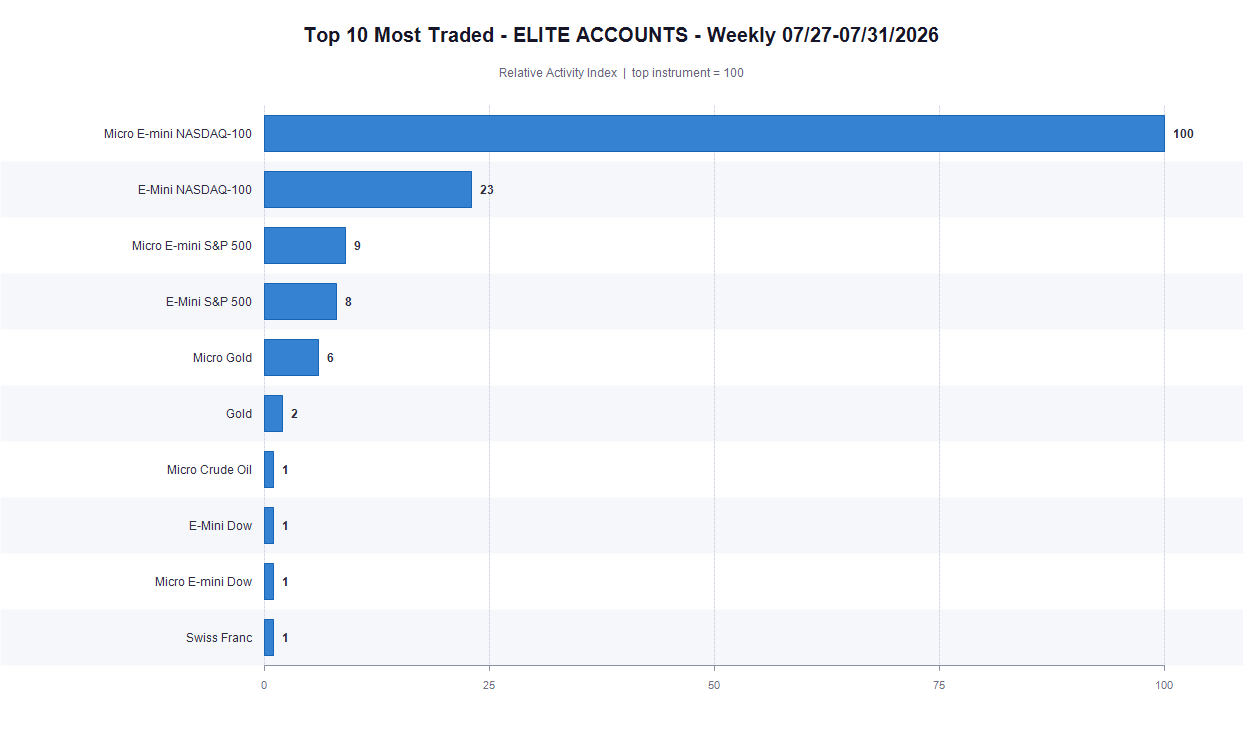
Micro E-mini NASDAQ-100 (MNQ) again led every instrument by trading volume among ELITE accounts, still the busiest contract on the board by a wide margin. E-Mini NASDAQ-100 (NQ) held the second spot, followed by Micro E-mini S&P 500 (MES) and E-Mini S&P 500 (ES). Micro Gold (MGC) and Gold (GC) rounded out the metals activity, while Micro Crude Oil (MCL) saw lighter but steady trading. E-Mini Dow (YM), Micro E-mini Dow (MYM), and Swiss Franc (6S) closed out the top 10 most traded instruments.
For the full breakdown of instruments ELITE accounts can trade, see ETF's What Instruments Can I Trade guide; for ticker symbols across contract families specifically, see the Forex and Futures Symbol Guide. A week where the heaviest loss lands on the session that felt safest to hold through is also a good moment to revisit trailing drawdown mechanics before adding size back in; ETF's Trailing Drawdown Calculator models how a trailing stop moves with account equity over a series of trades.
Where the Profits Went
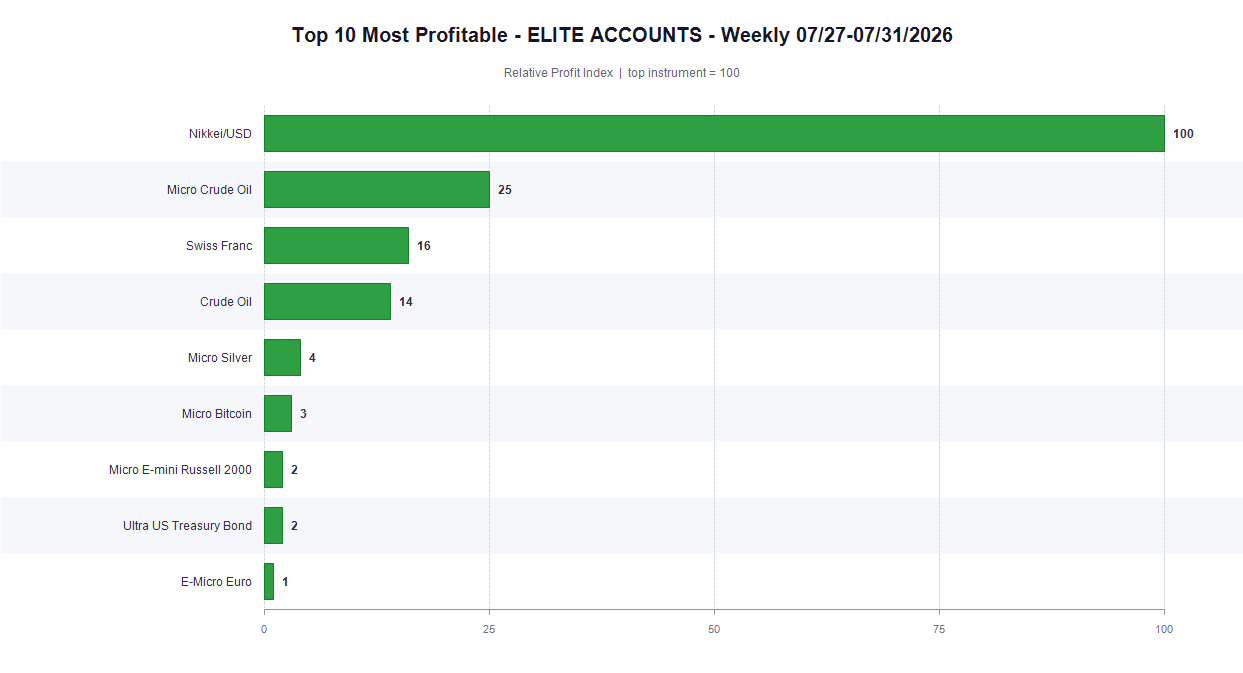
Nikkei/USD (NKD) led every instrument in profit this week, nearly four times the size of the next-best performer. Micro Crude Oil (MCL) took the second spot, followed by Swiss Franc (6S), Crude Oil (CL), and Micro Silver (SIL). Micro Bitcoin (MBT), Micro E-mini Russell 2000 (M2K), Ultra U.S. Treasury Bond (UB), and E-Micro Euro (M6E) rounded out the list. It was a short one this week: only nine instruments finished the week in the green at all.
Currency and energy names carried nearly the entire green column this week, with the broad index complex shut out of the profit list entirely.
Where the Losses Went
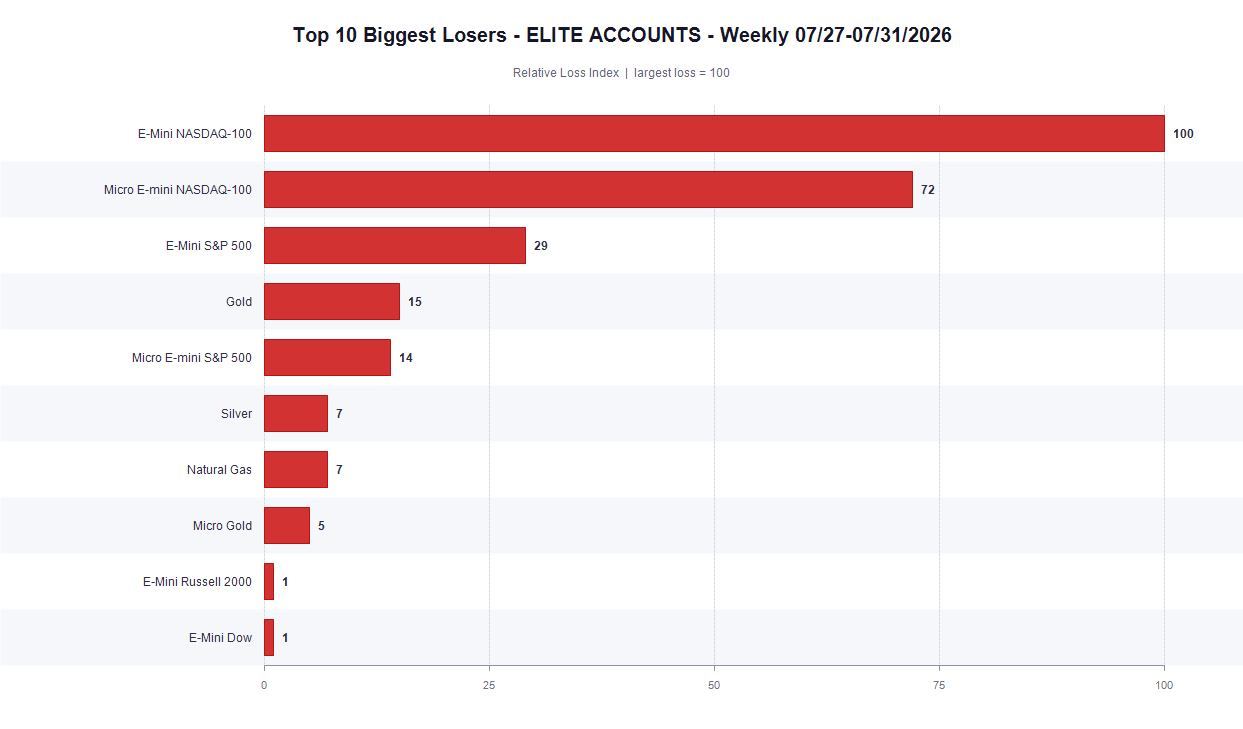
E-Mini NASDAQ-100 (NQ) posted this week's single largest loss, ahead of Micro E-mini NASDAQ-100 (MNQ) in second. E-Mini S&P 500 (ES) took the third spot, followed by Gold (GC) and Micro E-mini S&P 500 (MES). Silver (SI), Natural Gas (NG), Micro Gold (MGC), E-Mini Russell 2000 (RTY), and E-Mini Dow (YM) rounded out the top 10 loss instruments.
It is a reversal from last week, when E-Mini S&P 500 (ES) led the entire week in profit while the rest of the index complex struggled; see ES vs MES Futures: Full-Size Wins, Micro Loses. This week ES joined NQ and MNQ back in the loss column, and the entire index complex, full-size and micro alike, finished net negative.
The Day-by-Day Reversal
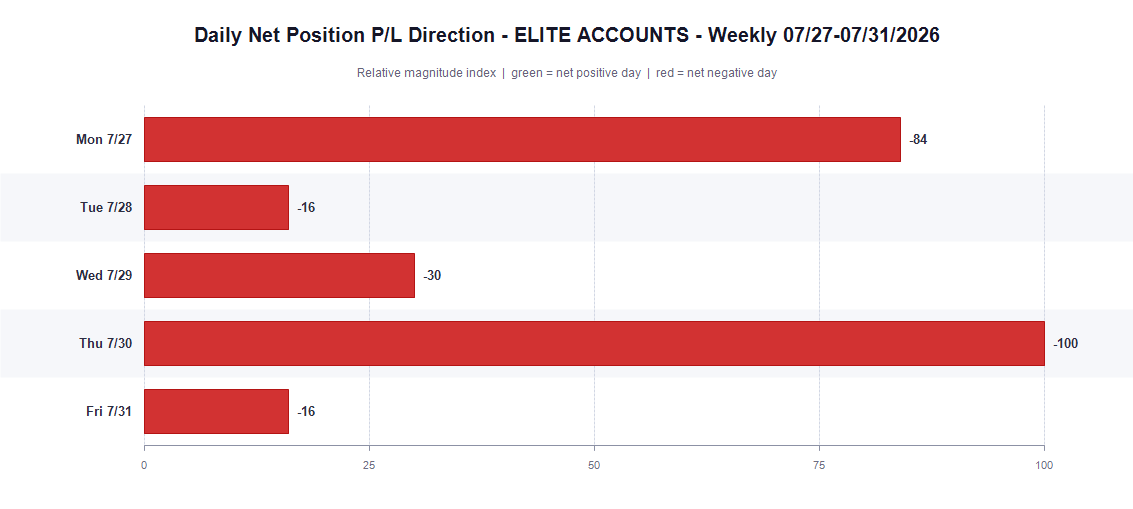
Every session of the week closed net negative for ELITE accounts, though the size of each day's loss varied sharply. Monday and Thursday carried by far the heaviest damage; Tuesday, Wednesday, and Friday all closed with comparatively modest losses.
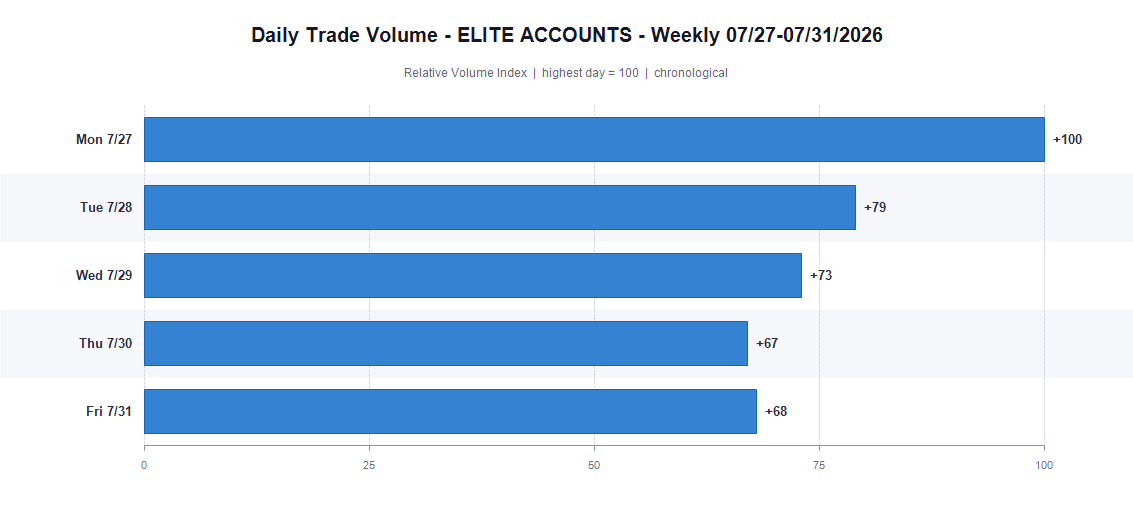
- Mon 7/27: Relative volume highest of the week - Net Loss (2nd Heaviest)
- Tue 7/28: Relative volume high - Net Loss (2nd Lightest)
- Wed 7/29: Relative volume moderate - Net Loss (Middle)
- Thu 7/30: Relative volume lowest of the week - Net Loss (Heaviest)
- Fri 7/31: Relative volume low - Net Loss (Lightest)
Public market reporting shows the calendar week carried real volatility of its own. Monday, ELITE accounts' second-heaviest loss day, coincided with a mixed session where the Dow edged higher and the S&P 500 was roughly flat, but the Nasdaq slipped as Nvidia dropped sharply on renewed AI-valuation concerns, even as oil prices fell on a pause in US-Iran hostilities. Wednesday brought the Federal Reserve's rate decision: the Fed held rates steady despite three dissents pushing for tighter policy, and all three major indexes sold off hard, with the Dow posting its worst single-day decline since April 2025. Thursday, ELITE accounts' single heaviest loss day, coincided with the sharpest reversal of the week, a rally led by Microsoft's AI-spending results that sent the Nasdaq up nearly three percent and lifted the S&P 500 and Dow as well. Friday closed out the month with continued gains across all three indexes as Big Tech earnings, including a large jump in Amazon on cloud growth, reassured investors, even as the Nasdaq finished July down for the month overall. None of this is presented as a cause of ELITE accounts' results, only as verified market context for the same calendar days.
How Volume Moved Through the Week
Monday carried the week's heaviest trading volume among ELITE accounts, well ahead of every other session. Thursday saw the lightest activity of the entire week, the same session that produced the week's single largest loss.
Pattern Section
Streaks and frequency data we're watching:
- E-Mini NASDAQ-100 (NQ) has now been a top-10 loss instrument for 23 consecutive weeks.
- Micro E-mini NASDAQ-100 (MNQ) has held the #1 volume spot for 23 consecutive weeks.
- Micro E-mini S&P 500 (MES) has been a top-10 loss instrument for 9 consecutive weeks.
- E-Mini Dow (YM) has been a top-10 loss instrument for 4 consecutive weeks.
- Micro Gold (MGC) has been a top-10 loss instrument for 4 consecutive weeks.
- Swiss Franc (6S) has been a top-10 profit instrument for 4 consecutive weeks.
- Micro Bitcoin (MBT) has been a top-10 profit instrument for 6 consecutive weeks.
About ELITE Accounts at Elite Trader Funding
ELITE accounts are sim-funded. The trading activity in these recaps reflects position P/L in sim accounts, not Live Elite rewards. Traders reach an Elite Sim-Funded account either by passing an evaluation or by purchasing Direct to Funding (DTF), which skips the evaluation step, and those who do well may progress to Live Elite, where rewards use real capital and there is no cap.
For a full explanation of how rewards work at each stage, see How Prop Firm Payouts Work: Sim vs Live vs Guaranteed. For daily reward structure specifics, see Daily Payout Prop Firms: How Live Elite Pays You. For the longer-running story behind NQ's presence in the loss column, see NQ Futures Prop Firm: Sixteen Weeks in the Loss Column.
ETF is a futures prop firm for traders who want uncapped Live Elite rewards, built on evaluation paths and account options for every stage of that journey. Evaluations are available on our Evaluations page, including a 100K Diamond Hands Evaluation for traders who want to start small.
Real trader results, community feedback, and program details are available on our Testimonials, Rewards, Affiliates, and Competitions pages.
The Elite Trader Funding app is available now. Install it and enable push notifications to get real-time alerts on your account. Launch bonus: enable notifications when you install and receive a free Evaluation Reset.
Install the ETF app and set up push notifications.
Pricing and Product Disclaimer: Pricing, promotions, and product details referenced in this article reflect information available at the time of publication and may have changed. Visit our Evaluations page for current pricing.