

Micro vs Mini Futures: Micros Came Out Ahead | ELITE Tape
Micro vs mini futures: micro contracts came out ahead of full-size in four of five markets ELITE traded this week, even after adjusting for size.
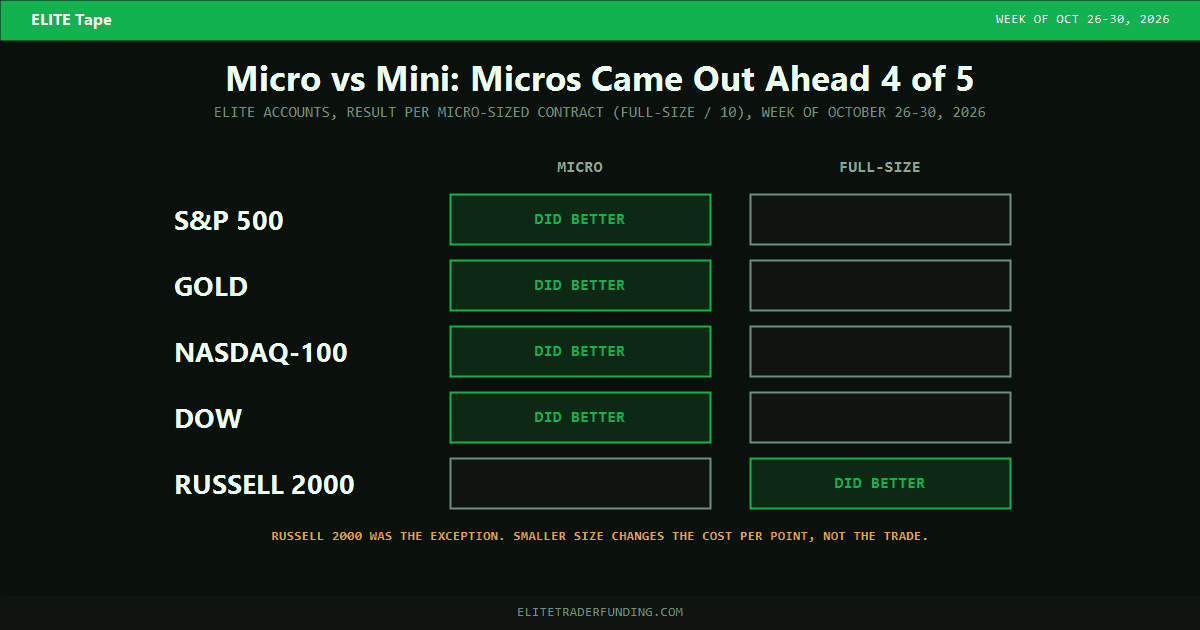
Micro vs Mini Futures: The Smaller Contract Came Out Ahead in Four of Five Markets

In the micro vs mini futures matchup this week, the micro contract came out ahead of its full-size version in four of the five markets ELITE accounts traded most: the S&P 500, gold, the Nasdaq-100 and the Dow. Micro E-mini S&P 500 (MES) finished as the week's top profit instrument while E-Mini S&P 500 (ES) lost on all five sessions.
ETF is a futures prop firm for traders who want uncapped LIVE ELITE withdrawals, and this week shows why contract size is a real trading decision, not a technicality. The same market can pay on the smaller contract and charge on the bigger one. If you're choosing between micros and minis, the numbers below show what that choice looked like in a week that ran from an AI rally to a Fed decision to a tech selloff.
Key Takeaways
- Micro contracts carried about three of every four ELITE trades and less than a tenth of the week's net loss.
- Micro E-mini S&P 500 (MES) finished green, and Monday and Tuesday, the two days of the AI-led rally, made essentially all of its week. E-Mini S&P 500 (ES) finished red on every session, those two days included.
- The edge held after adjusting for size. Measured per micro-sized contract (ten micros per mini, the same ratio ETF uses for position limits), micros did better than minis in the S&P 500, gold, the Nasdaq-100 and the Dow.
- E-Mini S&P 500 won more of its trades than Micro E-mini S&P 500 did, and still lost. Its average losing trade was a little over twice its average winning trade.
- The Russell 2000 went the other way: E-Mini Russell 2000 (RTY) finished green and Micro E-mini Russell 2000 (M2K) finished red, in the smallest of the five pairs.
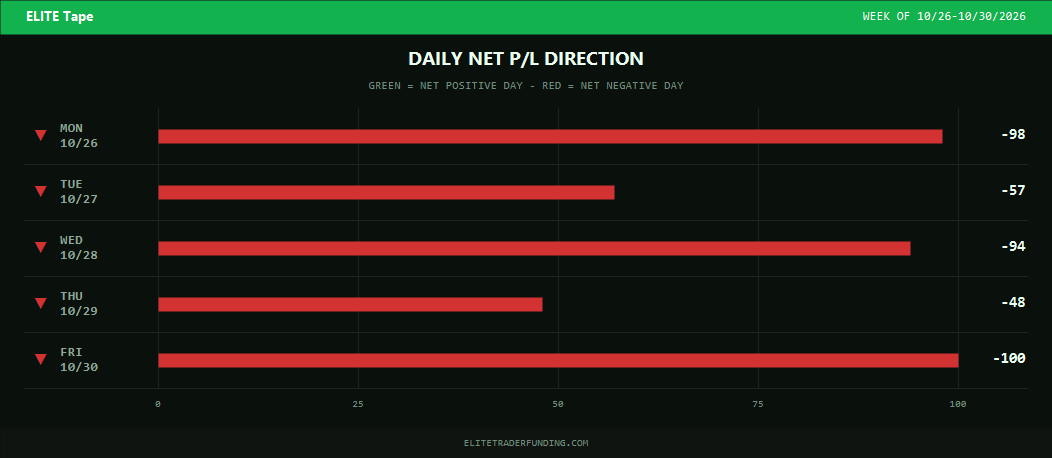
- All five sessions finished red. Friday's tech selloff was the heaviest, with Monday nearly level.
Below: where ELITE volume went, the short profit list, the loss column, and how each day lined up with the real market.
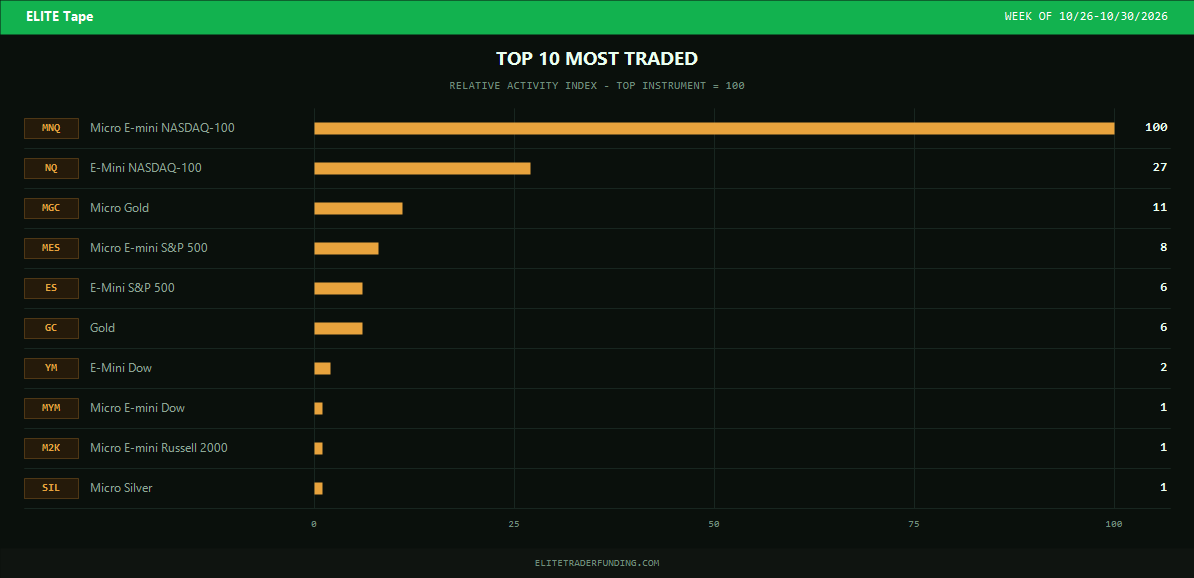
The Nasdaq-100 Pair Carried Nearly Four of Every Five Trades
Micro E-mini NASDAQ-100 (MNQ) led ELITE trading volume again, about three of every five ELITE trades on its own, with E-Mini NASDAQ-100 (NQ) second. Micro Gold (MGC) was third, followed by Micro E-mini S&P 500 (MES), E-Mini S&P 500 (ES), and Gold (GC). E-Mini Dow (YM), Micro E-mini Dow (MYM), Micro E-mini Russell 2000 (M2K), and Micro Silver (SIL) completed the top 10.
How traders split each market between micro and mini varied a lot. In the Nasdaq-100 and the Russell 2000, roughly four of every five trades were micros. Gold leaned micro by about two to one, and the S&P 500 was close to an even split. The Dow went the other way: about four of every five Dow trades were on the full-size E-Mini Dow. A micro contract tracks the same index or metal in a smaller size, and on most ETF plans ten micros count as one full-size position.
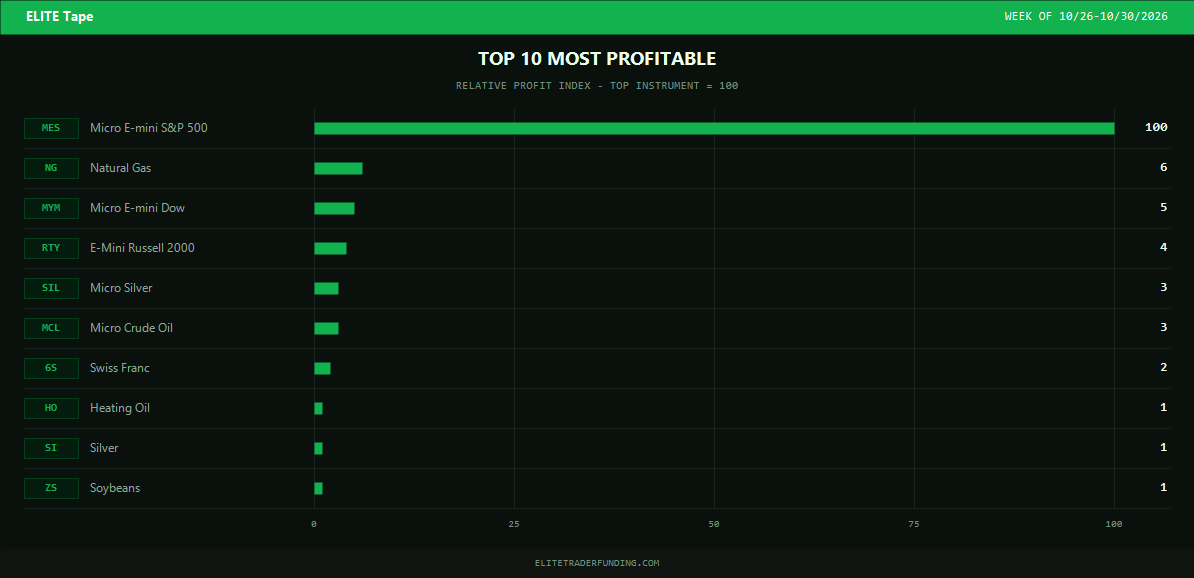
Micro S&P 500 Made More Than Three Times the Rest of the Profit List Combined
Micro E-mini S&P 500 (MES) topped the profit list by a wide margin, more than three times the other nine instruments combined. Natural Gas (NG) was second, followed by Micro E-mini Dow (MYM), E-Mini Russell 2000 (RTY), Micro Silver (SIL), Micro Crude Oil (MCL), Swiss Franc (6S), Heating Oil (HO), Silver (SI), and Soybeans (ZS).
Three of the top five were micros. MES did its work early: Monday and Tuesday, when the S&P 500 rose on an AI and chip rally, made essentially all of its weekly gain, and the rest of the week roughly netted out. Micro E-mini Dow finished green in a week when E-Mini Dow finished red.
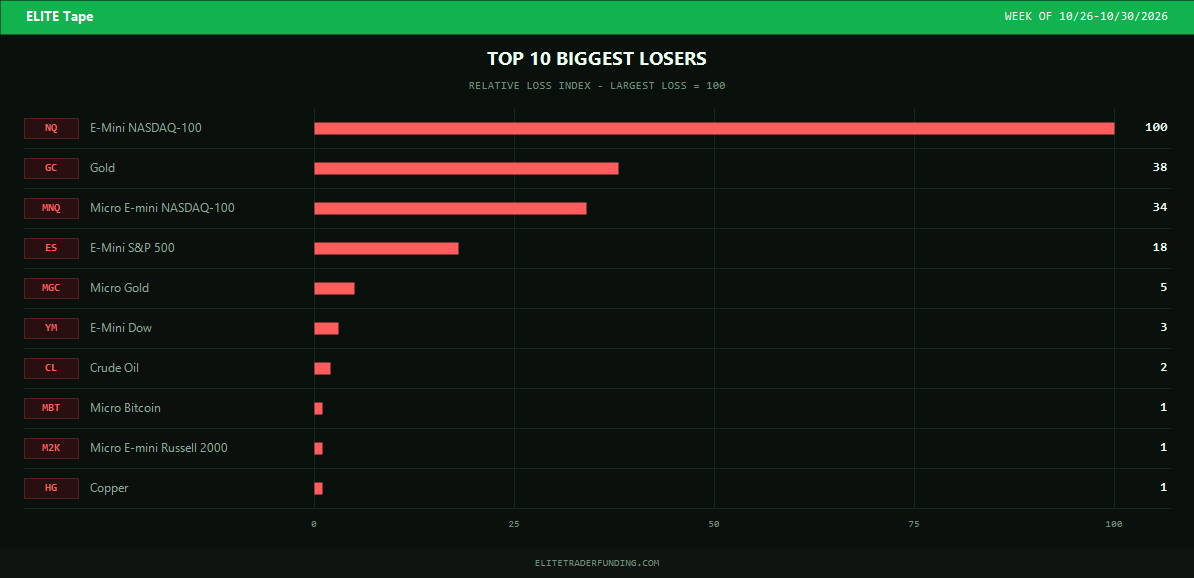
Full-Size Contracts Took Four of the Six Biggest Loss Spots
E-Mini NASDAQ-100 (NQ) led the loss column at about two and a half times Gold (GC) in second. Micro E-mini NASDAQ-100 (MNQ) was third, then E-Mini S&P 500 (ES), Micro Gold (MGC), E-Mini Dow (YM), Crude Oil (CL), Micro Bitcoin (MBT), Micro E-mini Russell 2000 (M2K), and Copper (HG). Four of the six biggest losses were full-size contracts.
Size explains part of that, since a full-size contract moves ten times as much per point. But it doesn't explain all of it. Scaled down to micro terms, MNQ and MGC each lost about half as much per contract as NQ and GC, and MES and MYM made money per contract while ES and YM lost.
The S&P 500 pair shows how. E-Mini S&P 500 trades won more often than Micro E-mini S&P 500 trades, about two in three against a little over half. But the average ES losing trade was a little over twice the average ES winning trade, while MES winners and losers were close to the same size. A higher win rate can still lose money when the losses run bigger than the wins. Before you pick a contract, ETF's Position Size Calculator shows how much a move costs on each size.
Picking your size before the next move? Browse available evaluations and choose the account size and drawdown style that fit how you trade.
An AI Rally, a Fed Hold, Then a Tech Selloff and Gold at a One-Year Low
All five sessions finished red for ELITE accounts. Friday was the heaviest loss, with Monday nearly level and Wednesday third. Tuesday and Thursday were the lightest.
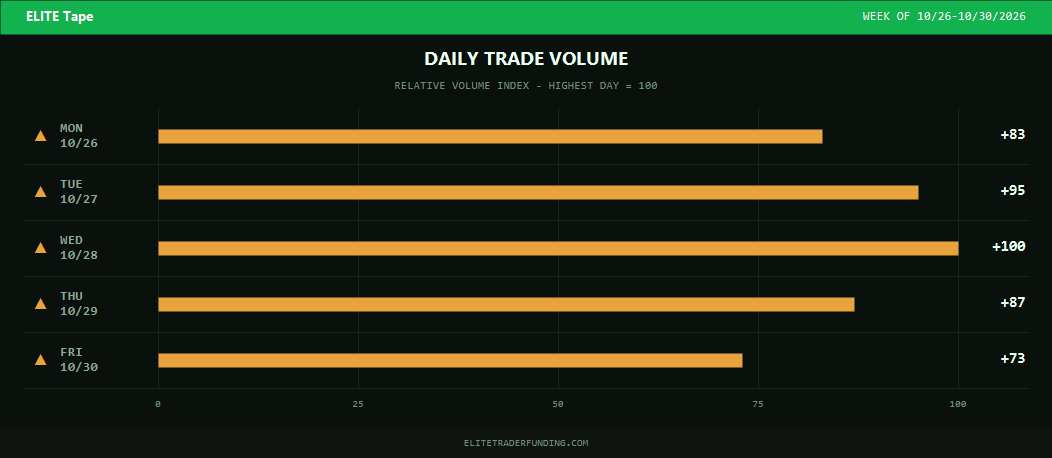
- Mon 10/26: Relative volume 4th highest of the week - Net Loss (2nd Heaviest)
- Tue 10/27: Relative volume 2nd highest of the week - Net Loss (4th)
- Wed 10/28: Relative volume highest of the week - Net Loss (3rd Heaviest)
- Thu 10/29: Relative volume 3rd highest of the week - Net Loss (Lightest)
- Fri 10/30: Relative volume lowest of the week - Net Loss (Heaviest)
Public market reporting shows a week that started with AI optimism and ended with a tech selloff. Monday, Anthropic's public filing to list on the Nasdaq revived AI enthusiasm and lifted chip stocks, and the S&P 500 rose 0.7%. Tuesday, the Nasdaq Composite gained 1.2% as the chip and AI rally ran a second day. Wednesday, the Federal Reserve held rates at 3.75% to 4.00% in a 10-2 vote, with both dissenters favoring a hike. Thursday, Alphabet fell about 12% after earnings, its worst day on record, and the Nasdaq Composite fell 1.4%. Friday, investors rotated out of tech, and the S&P 500 fell 1.8% and the Nasdaq 2.9%, both their worst days since June. Gold fell to its lowest level since October 2025. For the week, the S&P 500 fell 0.6% and the Nasdaq 2%, while the Russell 2000 rose 1.3%.
Set that next to ELITE results. The two rally days were the days Micro E-mini S&P 500 made its week, while E-Mini S&P 500 still finished red on both. Friday's selloff was ELITE's heaviest session, and Gold (GC) had its two worst days on Wednesday and Friday, the day gold hit its one-year low. None of this is presented as a cause of ELITE accounts' results, only as verified market context for the same calendar days.
Fed Day Was the Busiest Session, and Most of Its Loss Came Before 2 PM
Wednesday, the day of the Fed decision, carried the heaviest ELITE volume of the week, with Tuesday close behind. Friday, the heaviest loss, was the quietest session, so volume and losses landed on different days this week.
On Wednesday, about 70% of the day's net loss came on trades closed before the 2 PM ET decision. Trades closed in the first half hour after the announcement finished green as a group, before the afternoon turned red again.
Pattern Section
Streaks and frequency data we're watching:
- MES (Micro E-mini S&P 500): on the profit list for a 2nd straight week, and #1 this week.
- ES (E-Mini S&P 500) and MNQ (Micro E-mini NASDAQ-100): each a top-10 loss instrument for a 14th straight week. NQ (E-Mini NASDAQ-100) remains a fixture of the loss column since we've been tracking this data.
- MGC (Micro Gold): a top-10 loss instrument for a 5th straight week.
- Silver (SI): a top-10 profit performer for a 5th straight week.
- M2K (Micro E-mini Russell 2000): a top-10 most traded instrument for a 6th straight week.
Ready to Choose Between Micro vs Mini Futures?
The micro vs mini futures choice comes down to how much each point costs you and how much room that leaves your plan's drawdown. This week the smaller contract held up better in four of five markets, and the Russell 2000 is the reminder that it doesn't always. If you trade micros and like to give a position room to work, look at a Diamond Hands evaluation, built for holding positions longer (see how the Diamond Hands plan works). Want more than one account size or drawdown style? Add several evaluations to the cart and check out once.
About ELITE Accounts at Elite Trader Funding
ELITE accounts are sim-funded. The figures in these recaps are position P/L from those accounts, not LIVE ELITE results. Traders reach an Elite Sim-Funded account either by passing an evaluation or by purchasing a Direct to Funded (DTF) account, which skips the evaluation step, and those who do well may progress to LIVE ELITE, ETF's real-capital program, where withdrawals are uncapped above your onboarding balance.
Related Articles
- Gold Price Drop: Shorts Gained, Longs Lost (last week, when gold first slipped below 4,000 dollars)
- S&P 500 Futures: How MES Beat ES This Week (the last time the S&P micro outran the full-size contract)
- ES vs MES Futures: Full-Size Wins, Micro Loses (a week when it went the other way)
- MNQ Contract Size: The Bigger Bet Strikes Again (more on how contract size shapes results)
Elite Trader Funding offers evaluation paths for every stage on the way to uncapped LIVE ELITE withdrawals, whichever side of the micro vs mini futures choice fits how you trade. Evaluations are available for every account size. Real trader results, community feedback, and program details are available through ETF's testimonials, Elite Points program, affiliate program, and trading competitions.
Accuracy note: Figures in this recap are aggregated position P/L across ELITE accounts for October 26 to October 30, 2026, shown as relative indexes, shares and directions. They are not any individual trader's results. "Per micro-sized contract" compares each contract's net P/L per contract traded, with full-size contracts divided by ten. ELITE accounts on Tradovate are covered; a small number of ELITE accounts on other platforms are not included.
Risk Disclosure: ELITE accounts operate in a simulated trading environment. Futures trading involves substantial risk of loss, and past performance of simulated accounts is not indicative of future results.
Pricing and Product Disclaimer: Pricing, promotions, and product details referenced in this article reflect information available at the time of publication and may have changed. Visit the evaluations page for current pricing.