

ELITE Tape | E-Mini Russell 2000 Futures Led a Red September
E-Mini Russell 2000 futures earned more than twice the rest of September's profit column combined, while 31 instruments finished red for ELITE accounts.
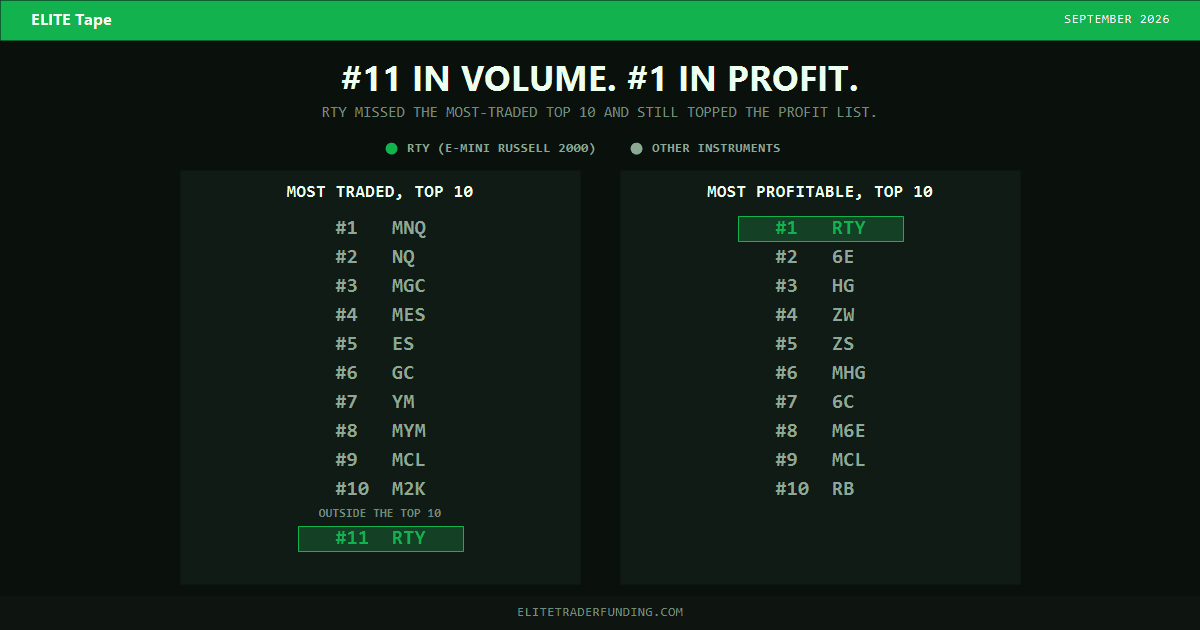
E-Mini Russell 2000 Futures Led a Red September

E-Mini Russell 2000 futures (RTY) earned more than twice what the rest of September's profit column made combined, and did it without cracking the month's top 10 most traded list.
ETF is a futures prop firm for traders who want uncapped LIVE ELITE rewards, and September makes a useful case for anyone who equates activity with results. The two most heavily traded contracts on the board produced most of the month's loss. The contract that finished on top barely traded at all.
Key Takeaways
- RTY topped September's profit list for ELITE accounts by a wide margin, more than twice the other eleven profitable instruments put together.
- Only 12 instruments finished the month in profit, and 31 finished in the red. RTY was the only index future on the profit side.
- The NASDAQ-100 futures pair, E-Mini NASDAQ-100 (NQ) and Micro E-mini NASDAQ-100 (MNQ), carried about four of every five ELITE trades and roughly 71% of the month's net loss.
- Week 3 (September 14-18) was both the busiest and the costliest week, about 40% of the month's loss on its own. It held the CME equity-index roll date, a Fed rate hike and the September contracts' expiration.
- For a trader, the takeaway is selectivity: the month's best result came from a contract most ELITE accounts never touched.
Below: where the volume went, the short list that finished green, what the NASDAQ-100 pair cost, and how September's five weeks stacked up against each other.
Two Contracts Took Most of the Month's Volume
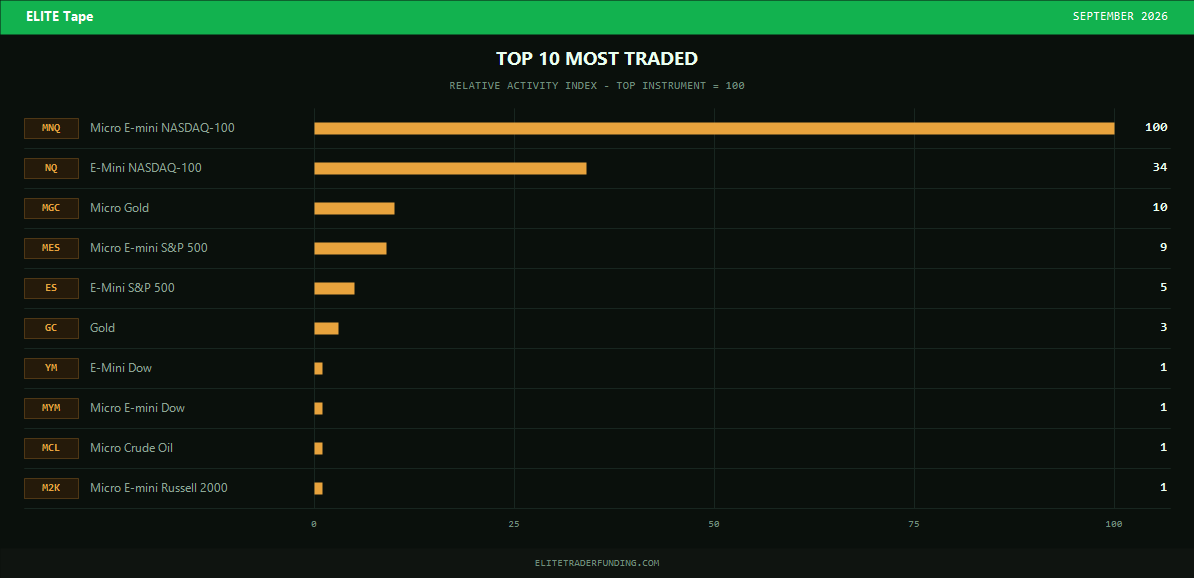
Micro E-mini NASDAQ-100 (MNQ) led every instrument in volume, nearly three times the activity of E-Mini NASDAQ-100 (NQ) in second. Micro Gold (MGC) held third, ahead of Micro E-mini S&P 500 (MES), E-Mini S&P 500 (ES) and Gold (GC). E-Mini Dow (YM), Micro E-mini Dow (MYM), Micro Crude Oil (MCL) and Micro E-mini Russell 2000 (M2K) closed out the top 10 most traded instruments for the month.
MNQ and NQ together made up about 81% of all ELITE activity. Both track the same index at different sizes; Nasdaq's own Nasdaq-100 index page explains how that index is built. For the full list of instruments ELITE accounts can trade, see ETF's What Instruments Can I Trade guide, and for ticker symbols across contract families, the Forex and Futures Symbol Guide.
September was also a quarterly rollover month. CME's customary roll date for US equity-index futures fell on Monday, September 14, with the September contracts expiring Friday, September 18. ELITE accounts moved fast: by Tuesday the 15th, the large majority of NASDAQ-100 futures volume had already shifted to the December contract.
Why the Month's Best Contract Barely Traded
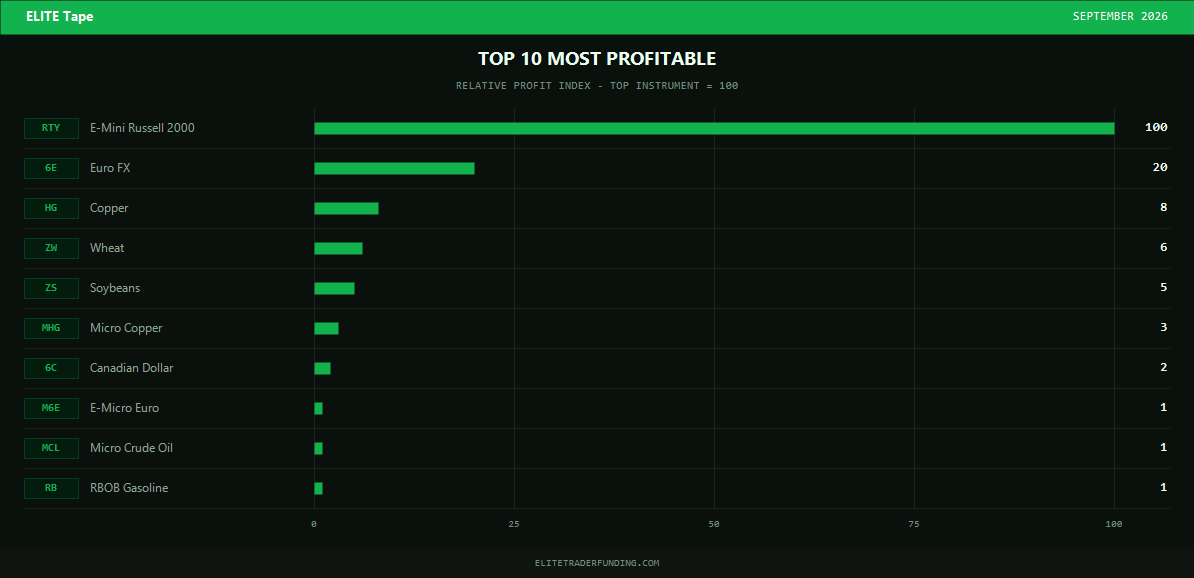
E-Mini Russell 2000 futures finished first in profit, and it wasn't close. Euro FX (6E) took second, with Copper (HG), Wheat (ZW) and Soybeans (ZS) behind it. Micro Copper (MHG), Canadian Dollar (6C), E-Micro Euro (M6E), Micro Crude Oil (MCL) and RBOB Gasoline (RB) rounded out the top 10 profitable instruments.
RTY was also August's top profit instrument, and it earned roughly double in September what it made in August. Its micro sibling told a different story. Micro E-mini Russell 2000 (M2K) traded more often than RTY and still finished the month a hair below break-even. Same index, separate contracts, separate positions.
The rest of the profit column was thin. Nothing from the NASDAQ, S&P or Dow complex, full-size or micro, finished September in the green. A profit list this short, with this much of its weight in one contract, is a reminder that a small number of good trades can matter more than a large number of busy ones. ETF's Trade Expectancy Calculator shows how win rate and average win and loss size combine into what each trade is worth over time.
What the NASDAQ-100 Pair Cost
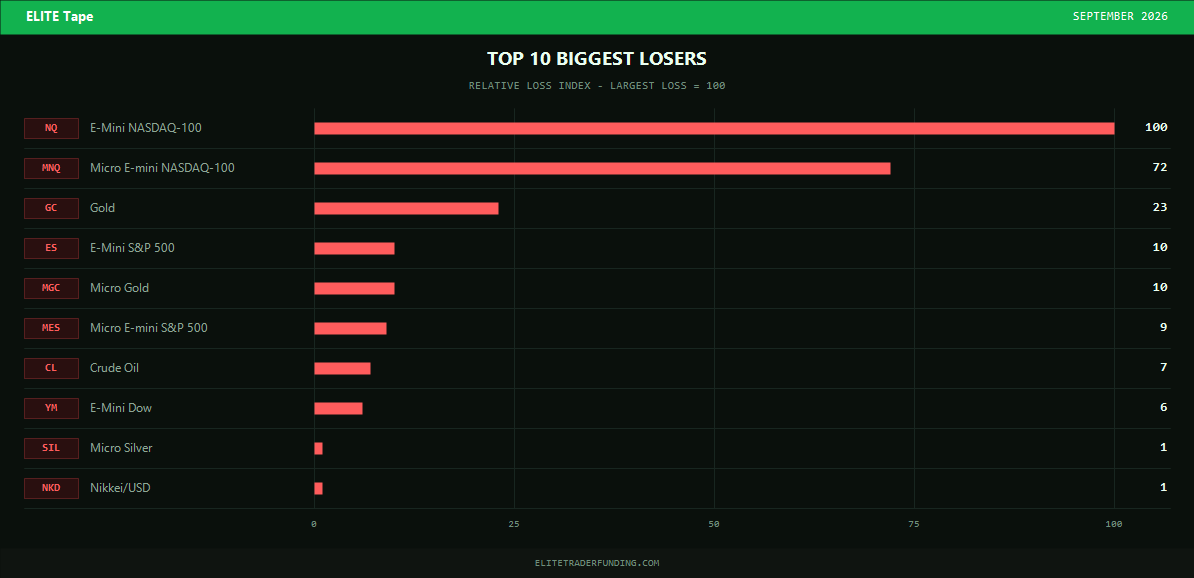
E-Mini NASDAQ-100 (NQ) was September's largest loss instrument, about 1.4 times the loss of Micro E-mini NASDAQ-100 (MNQ) in second, even though MNQ traded nearly three times as often. Gold (GC) held third, more than double the loss of E-Mini S&P 500 (ES) in fourth. Micro Gold (MGC), Micro E-mini S&P 500 (MES), Crude Oil (CL), E-Mini Dow (YM), Micro Silver (SIL) and Nikkei/USD (NKD) rounded out the top 10 loss instruments.
The Nasdaq itself had a decent month. Public market reporting shows the Nasdaq Composite gained 1.7% in September, while the Dow fell 4.9% and the S&P 500 slipped 0.7%. ELITE accounts still took their heaviest losses in the NASDAQ-100 pair. That's verified market context for the same calendar month, not an explanation of ELITE results, which come down to each trader's own direction, size and timing.
Thinking about how your own sizing would have held up in a month like this? Browse available evaluations, and if you want more than one account size or drawdown style, add each one to the cart and check out once.
Two Middle Weeks Did Most of the Damage
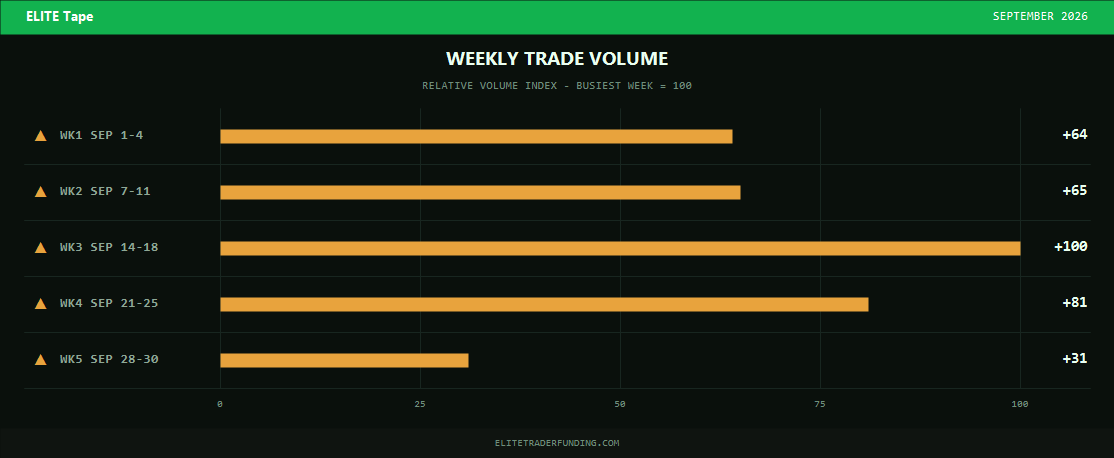
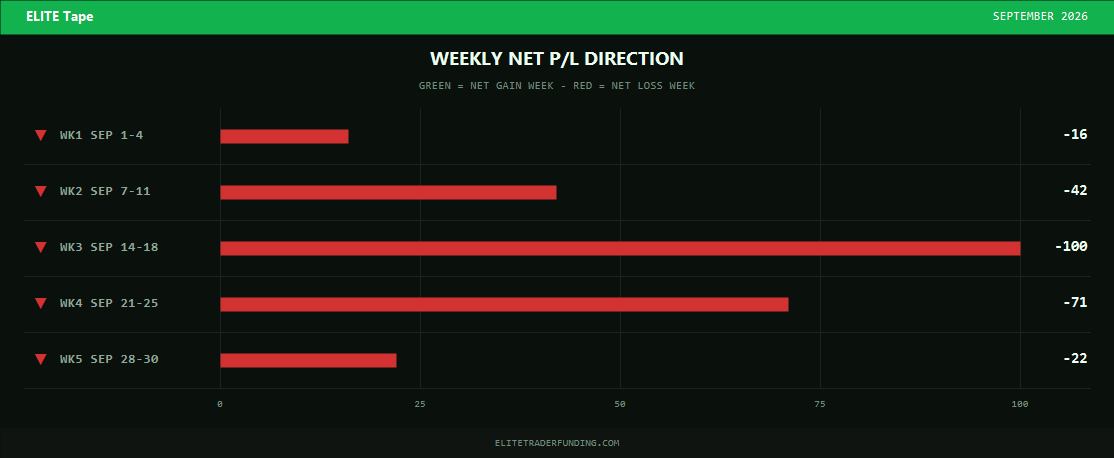
Every week closed net negative, but the weight sat in the middle of the month. Weeks 3 and 4 together produced more than two-thirds of September's loss. Unlike August, the busiest week this time was also the costliest.
- Week 1 (Sep 1-4): Four sessions, the in-month part of a week that began August 31 - Net Loss (mildest of the month, with two green sessions)
- Week 2 (Sep 7-11): Volume about level with Week 1 despite the Labor Day holiday - Net Loss (deeper than Week 1)
- Week 3 (Sep 14-18): Busiest week of the month - Net Loss (heaviest of the month, about 40% of the total)
- Week 4 (Sep 21-25): Second busiest - Net Loss (second heaviest)
- Week 5 (Sep 28-30): Three sessions, the trailing edge of a week that runs into October - Net Loss
Week 1 was the lightest loss of the month, and two of its four sessions finished green; see Micro Gold Futures: The Market's Worst Day Was ELITE's Best for that week's full breakdown.
Week 2 opened with Labor Day, the lightest session of the month and one of only four green sessions in September. The four regular sessions after it all finished red, with Friday the heaviest. Gold took the week's top loss spot; see Gold Futures: NQ Wasn't the Biggest Loser.
Week 3 was the month's low point and its busiest week. It began on the CME roll date, the Federal Reserve raised rates on Wednesday, September 16 for the first time since July 2023, and the September equity-index contracts expired that Friday. Not one session that week finished green; see NQ Futures: Not One Green Day, Even as the Fed Hiked. The calendar events are listed as timing only, not as a cause.
Week 4 held the single costliest session of the month, Monday, September 21; see NASDAQ-100 Futures: Rally Monday Cost the Most.
Week 5 covered only three sessions, Monday through Wednesday, since the calendar week it belongs to runs into October. That week's own full recap publishes separately once it closes.
Patterns and What We're Watching
- E-Mini Russell 2000 (RTY): the top monthly profit instrument for a second straight month, August and September.
- E-Mini NASDAQ-100 (NQ): the largest monthly loss instrument in both August and September, and a top-10 loss instrument in every week of September. In the weekly recaps, it hasn't left the loss column since we've been tracking this data.
- Micro E-mini NASDAQ-100 (MNQ): the #1 volume instrument in both August and September.
- Gold (GC): a top-10 loss instrument in all five weeks of September, and third for the month as a whole.
- Busiest week vs. worst week: in August, the busiest week posted the mildest loss of the full weeks. In September, the busiest week was the costliest.
Ready to Trade October on Your Own Terms?
Take September's lesson into your next session: the contract you pick and the size you trade mattered more than how often you traded. Start with an evaluation sized to how you trade, or pick an EOD Evaluation if you want your drawdown measured at the end of the day rather than tick by tick. Want more than one? Add several to the cart and buy them in a single checkout.
About ELITE Accounts at Elite Trader Funding
ELITE accounts are sim-funded. The trading activity in these recaps reflects position P/L in sim accounts, not LIVE ELITE rewards. Traders reach an Elite Sim-Funded account either by passing an evaluation or by purchasing Direct to Funded (DTF), which skips the evaluation step, and those who do well may progress to LIVE ELITE, ETF's real-capital program, where there is no cap on rewards.
Related Articles
- August 2026 Futures Trading Recap: Every Week Landed in the Red (last month, when RTY also led the profit column)
- What Is EOD Drawdown? End of Day vs Intraday Trailing (how end-of-day drawdown works)
- How Prop Firm Payouts Work: Sim vs Live vs Guaranteed (how rewards work at each stage)
ETF is a futures prop firm for traders who want uncapped LIVE ELITE rewards, built on evaluation paths and account options for every stage of that journey, whether you trade E-Mini Russell 2000 futures or any other supported contract. Evaluations are available for every account size, including the EOD Evaluation.
Real trader results, community feedback and program details are available through ETF's testimonials, Elite Points program, affiliate program and trading competitions.
Accuracy note: Figures in this recap are aggregated position P/L across ELITE accounts for September 1-30, 2026, shown as relative indexes, shares and directions. They are not any individual trader's results.
Risk Disclosure: ELITE accounts operate in a simulated trading environment. Futures trading involves substantial risk of loss, and past performance of simulated accounts is not indicative of future results.
Pricing and Product Disclaimer: Pricing, promotions, and product details referenced in this article reflect information available at the time of publication and may have changed. Visit the evaluations page for current pricing.